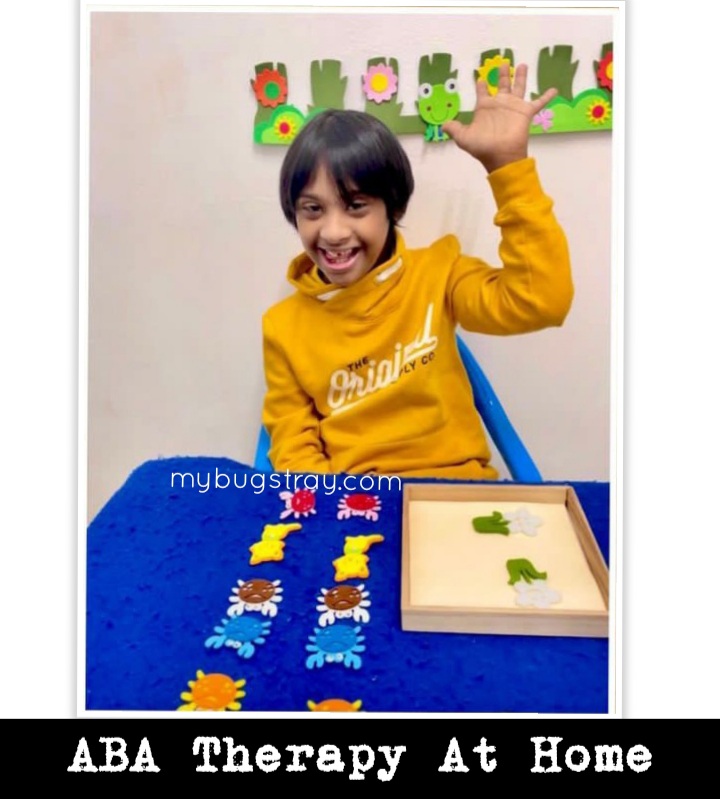
What is ABA Therapy?
The rate of Autism Spectrum Disorder (ASD) has been rising since 2010 in Malaysia. Today, ASD has become common among kids, especially in preschool where we can identify the symptoms and characteristics in a child. One of the good news is autism can be treated by early interventions and practices.
Applied Behavior Analysis (ABA) is a technique frequently used for guiding autistic children to understand and modify their behavior. This method can assist children with autism and other developmental delays in learning new skills and enhancing their behavior through repeated practice of tasks.
How can I teach ABA activities at home?
As a parent, you play a crucial role in helping your children improve their skills and behavior. To achieve this, ABA activities can be an effective technique to assist your children in reaching their goals. However, it’s important to remember that your child may not perform well at first, so don’t get frustrated. Instead, stay patient and confident, and both you and your child will eventually reap the rewards of your efforts. Here are some basic tasks you can do at home to train your children.
EYE CONTACT
Here are some activities that can help your child stay focused and maintain eye contact:
- Stick stickers on your face and let your child touch them.
- Play peek-a-boo or make funny faces and sounds to draw their attention.
- Toss a ball up and say “up,” then catch it and say “catch.” Put the ball on your child’s palm with a surprise and say “yeay!”
- Use musical toys with lights and rattles to grab your child’s interest.
- Play simple games like blowing bubbles and feathers to encourage your child to respond and make eye contact.
These activities are fun and engaging ways to help your child develop their attention skills and maintain eye contact.
Engaging in games that require fine motor and gross motor skills can help a child maintain focus and improve their hand-eye coordination. It’s important to avoid persistently nagging your child, such as by repeatedly saying “Look here!” or forcibly redirecting their attention by pulling their face or cheeks. This can cause irritation and disinterest in completing tasks.
The first basic task to train children with ASD and other developmental delays is to sit in a chair. It can be challenging, especially for those who experience hyperactivity and struggle to focus on their tasks. However, with regular practice of sitting in the chair to perform their activities, they will eventually adapt and accept our instructions.
When working with a child, it’s best to have them sit facing you so they can easily see and follow your instructions. It’s also important to train them to sit in a chair during meal times and while performing activities. To encourage and build their confidence, be sure to praise them frequently every few seconds. This will also help strengthen the relationship between the child and the instructor.
MATCHING ACTIVITIES
Matching activities are an essential way to improve memory power in pre-reading. For instance, people with Down Syndrome typically struggle with short-term memory and auditory memory, which involves remembering sounds heard verbally.
Auditory memory can also make it challenging to distinguish between different sounds and blend them together. Reading using a phonological approach that focuses on each sound of the alphabet poses difficulties for individuals with deficits in auditory processing or short-term memory.
For instance, trying to read the word ‘Bag’, is a simple 3-letter word, but in order to do so, the brain uses multiple processes. First, remember the sound of the letter B’, the sound of A’, and then G’. Third, blend all the letters’ sounds in the correct order from B, A to G. At last, remember what the word BAG’ means.
The phonological approach will be tough for individuals who with deficit in auditory memory and short memory. The best activities to improve reading will be matching.
Matching the same colors with the toys that are familiar to your child. For example (red and yellow flashcards with toy red apple and banana).
IDENTIFY THE EMOTIONS
To help your child understand their emotions, print out flashcards featuring different emotions such as happy, sad, crying, and grumpy. Show the cards to your child and make a sad face, allowing them to pick and name the emotions. You can even pretend to play with the emotion cards together. This activity can be helpful in promoting emotional awareness and understanding for your child.
SORTING SIMPLE PUZZLES
Sorting puzzles by shapes, colors, fruits, animals, and home appliances helps children remember and identify them easily. This activity also promotes independent reasoning and decision making.
REINFORCEMENT
Encouraging good behavior through positive reinforcement can have a significant impact on a child’s self-esteem. Praising their efforts, no matter how small, and offering hugs or other forms of affection can be motivating and boost their confidence. This approach should always be sincere, as it will help the child feel proud of themselves and encourage them to be more responsible in their daily activities.
 MY BUGS' TRAY